How to Prevent Guitar Fret Sprout: Why Botanical Lipids Stop Winter Wood Shrinkage
By David Aitken · The Complete Guitar · Ballindean Road Workshop, Dundee
Every October like clockwork, the messages start landing in my inbox with the same baffled complaint: “David, this neck was slick and buttery in July, but now sliding up to the 7th fret feels like running my thumb along a bread knife. Have the frets worked loose, or have they somehow grown?”
Frets do not grow. Metal does not expand when Scottish weather turns cold and damp outside. What actually happens is: the central heating turns on, radiators hiss, indoor relative humidity drops, and the hygroscopic wood of your guitar fingerboard begins to gasp for moisture.
This guide untangles why guitars develop sharp fret ends as winter arrives, why proper botanical hydration is vital for prevention, why simply oiling a neck that has already sprouted rarely stops it coming back, and why having a professional luthier address the fret ends on the bench is the definitive permanent fix.
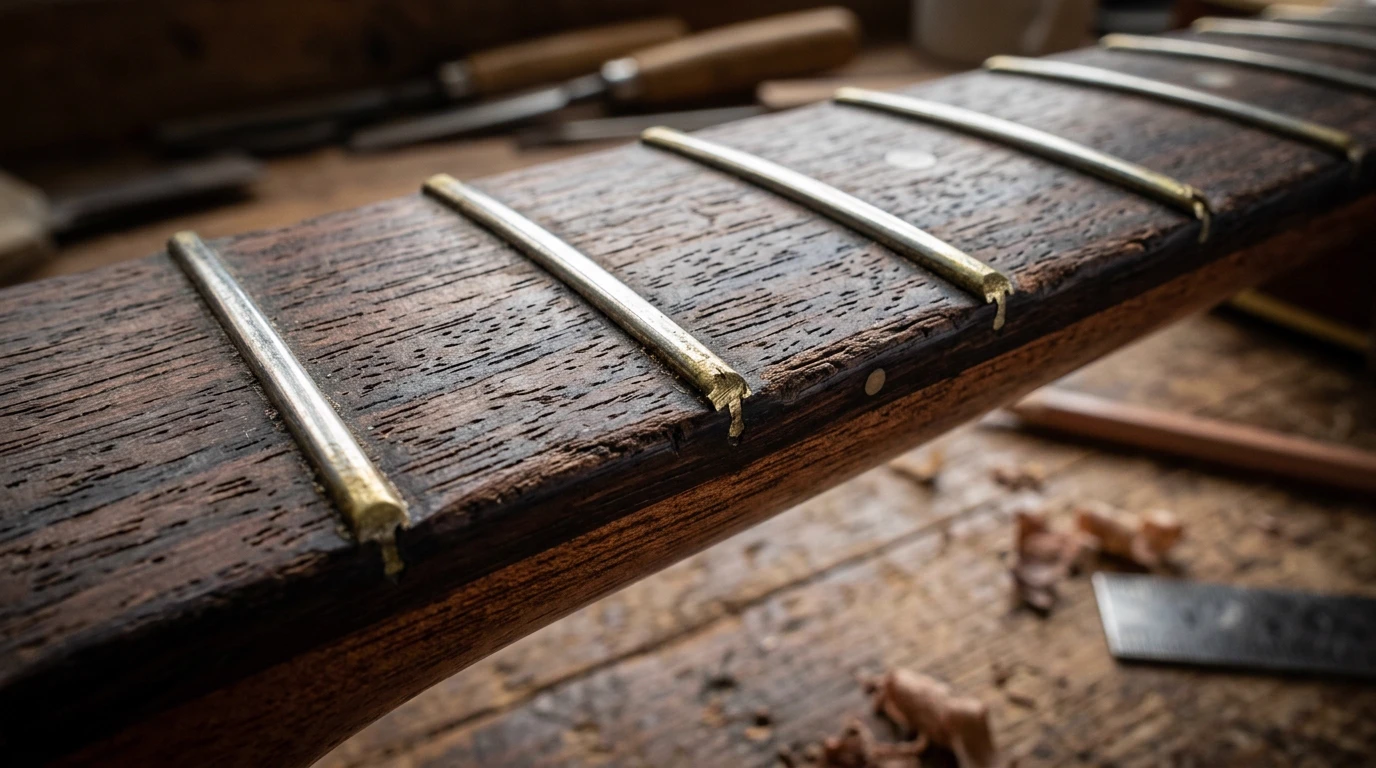
The Autumn Bench Puzzle: The Stratocaster That Turned Into a Grater
A client contacted me last autumn regarding an American Performer Stratocaster with a dark, open-pore rosewood board. In mid-summer, it was his favourite instrument. By late October, the fret edges along both the bass and treble sides were so aggressive that he could barely play without nicking his skin.
He had brought it to a friend who told him the frets had lifted and that he needed to hammer them back down. When that did nothing, another acquaintance told him the neck was ruined and needed aggressive metal filing right down the tangs.
I put the guitar on my bench and ran a methodical diagnostic check. I refuse to guess when a few measurements tell the whole story:
Yet running a finger down the edge of the fingerboard felt like dragging skin across a coarse metal rasp. The fret wire had not moved upwards. The timber had shrunk inwards.
The Anatomy of Fret Sprout: Why Winter Air Shrinks Tonewood
To solve fret sprout, you have to understand how tonewood behaves when ambient air dries out.
Wood is hygroscopic. It breathes moisture in and out continuously, constantly seeking equilibrium with the surrounding relative humidity (RH). During a Scottish summer, indoor RH often hovers between 55% and 65%. The open grain of an unfinished fingerboard — whether Indian rosewood, African ebony, or alternative fingerboard tonewoods like Pau Ferro and Laurel — absorbs ambient vapour. The wood cells swell gently, puffing back out to the width where the luthier or factory levelled and bevelled the fret ends flush.
Then October arrives. Outside temperatures drop. Central heating kicks in across Dundee, Dundee flats seal their double glazing, and indoor relative humidity drops down to 25% or 30%.
                     THE WINTER WOOD SHRINKAGE CYCLE
┌──────────────────┐        ┌──────────────────┐        ┌──────────────────┐
│ Central Heating  │ ─────► │ Wood Cells Lose  │ ─────► │ Fingerboard      │
│ Dips Room RH <35%│        │ Bound Moisture   │        │ Shrinks Widthwise│
└──────────────────┘        └──────────────────┘        └──────────────────┘
                                                              │
                                                              ▼
┌──────────────────┐        ┌──────────────────┐        ┌──────────────────┐
│ Razor-Sharp Fret │ ◄───── │ Metal Fret Tangs │ ◄───── │ Wood Contracts   │
│ Sprout Protrudes │        │ Cannot Contract  │        │ Past Fret Ends   │
└──────────────────┘        └──────────────────┘        └──────────────────┘
Wood shrinks along its grain dimensions in an unequal manner. While a neck barely shrinks in length (longitudinally), it contracts dramatically across its width (tangentially and radially). In dry air, an unfinished rosewood board can easily shrink by 0.2mm to 0.4mm across the width of the neck.
Metal does not care about humidity. The nickel-silver fret wire and the barbed fret tang hammered into the wood slot remain exactly the same width regardless of room moisture.
When the fingerboard contracts laterally, the rigid metal ends of each fret are left protruding out into open air past the bevelled edge of the timber. That is fret sprout.
The Tool-Seller Trap: Why Amateur DIY Filing Fails (And What Actually Solves It)
If you browse guitar forums or watch commercial maintenance channels, their immediate advice is almost always: “Buy a cheap fret-end file online and grind those ends flush yourself!”
Commercial brands love telling you to buy files because tools carry high retail margins. But amateur DIY filing at home is a recipe for heartbreak. Without safe-edge files, proper neck support, and experienced hands, players routinely gouge fretboard binding, scratch delicate lacquer, or file steep, uneven bevel angles that cause the high E string to slip right off the fingerboard during solos.
At the other extreme, players are often told: “Just rub on some oil and the frets will pull right back.”
Here is the reality: proper hydration is something that helps prevent fret sprout, and it stops it coming back once addressed. But if your guitar has already experienced fret sprout, there is a very high chance it will return every winter if you only rely on oil. Swelling the wood temporarily masks the symptom, but the underlying seasonal shrinkage cycle remains.
Actually having a professional luthier address the fret sprout on the bench is the permanent fix. When a luthier dresses the fret ends while the neck is in its contracted state, the metal is physically brought flush with the wood edge, bevelled at an exact 35-degree angle, recrowned, and mirror-polished. It can never protrude again. Once permanently corrected on the bench, regular botanical hydration seals the wood cells and stops sprout from ever returning.
The Bench Struggle: A Stubborn Pau Ferro Neck
A few years ago, a player brought in a guitar with a Pau Ferro fingerboard that had spent three years hanging on an external wall directly above a storage radiator in a flat near the Dundee harbour. The wood had turned a chalky, pale grey colour, and the fret ends felt like shark teeth.
I took the guitar in for triage.
I decided to try a quick commercial rehydration mist that a supplier had sent me to test. I wiped it on, let it sit, and set the guitar on the rack.
For about a week.
When I checked the neck seven days later, the chalky grey finish was back, the timber was dry as bone, and the fret ends were as sharp as when the guitar arrived. The water-based mist had evaporated into thin air, leaving the wood cells even thirstier than before.
I refuse to be defeated by a guitar. If an instrument leaves my bench without playing cleanly, my work is not done. I always tell players facing stubborn acoustic buzzes or neck alignment mysteries: I won't charge you if I can't find it.
I stripped the hardware, placed the guitar in an environmentally stabilised enclosure, and applied a dedicated formulation of cold-pressed botanical lipids. Within four days, the thirsty wood cells drank in the lipids, the chalky grey timber deepened into rich espresso tones, and moisture balance was restored.
However, I didn't just hand the guitar back and call it a day. When an instrument has already experienced severe fret sprout, relying solely on hydration is a gamble: there is a high chance the sharp ends will reappear the moment indoor heating kicks in again...
The permanent fix was to put the neck on the bench and address the fret sprout properly. I dressed each fret end flush with the fingerboard margin, cut a uniform 35-degree bevel, and recrowned and mirror-polished every corner. Finally, I sealed the wood with a finishing application of Resonance Balm. That combination — a permanent bench dress followed by protection — meant that guitar has stopped biting.
Mineral Oil vs. Botanical Lipids: Why “Lemon Oil” Fails the Winter Test
The standard high-street remedy for a dry fingerboard is a bottle of “guitar lemon oil.” Many players believe they are feeding their wood with natural fruit oil.
In reality, almost every commercial bottle of guitar lemon oil is inexpensive mineral oil — a liquid paraffin petroleum distillate — spiked with artificial yellow dye and synthetic citrus scent.
Petroleum mineral oil is not tonewood food. It consists of non-polar, long-chain aliphatic hydrocarbons. Because it lacks the biochemical ester structures found in natural plant fats, mineral oil cannot bond with the cellulose and lignin inside wood cells.
When you rub mineral oil onto a dry rosewood or ebony board, it sits in the superficial surface pores. It darkens the wood for forty-eight hours, giving a false impression of health. But within days, it evaporates into the dry winter air. As it evaporates, it carries away the trace natural oleoresins that the timber originally retained, leaving the wood fibres drier and more brittle than before you applied it.
To stop fret sprout, open-pore woods require cold-pressed botanical lipids.
| Petroleum “Lemon Oil” (Commercial Standard) | Cold-Pressed Botanical Lipids (Resonance Balm) |
|---|---|
| • Liquid paraffin crude petroleum distillate | ✓100% pure plant-derived lipids (Jojoba & Sweet Almond) |
| • Sits superficially in upper pores without cellular uptake | ✓ Deep xylem capillary uptake into cellular tracheids |
| • Evaporates in dry room air within 3–7 days | ✓ Bonds to cellulose fibrils, remaining stable 6–12 months |
| • Strips natural oleoresins, leaving timber chalky & brittle | ✓ Forms lasting elastic moisture barrier against shrinkage |
| • Acidic citrus solvents soften nitro lacquer & fret glue | ✓ 100% finish, binding, and fretboard glue safe (pH 6.8) |
Cold-pressed botanical oils — particularly jojoba and sweet almond — behave differently. Jojoba is biologically a liquid wax ester whose molecular weight closely mirrors the natural protective waxes of living trees. When massaged into rosewood, ebony, Pau Ferro, or Indian Laurel, it penetrates deep into the xylem tracheids.
It does not evaporate. It binds to the cell walls, forming a stable, breathable moisture barrier that slows transpiration. When room humidity swings between 30% and 60%, a botanically hydrated board stays stable, preventing the severe cross-grain shrinkage that creates fret sprout.
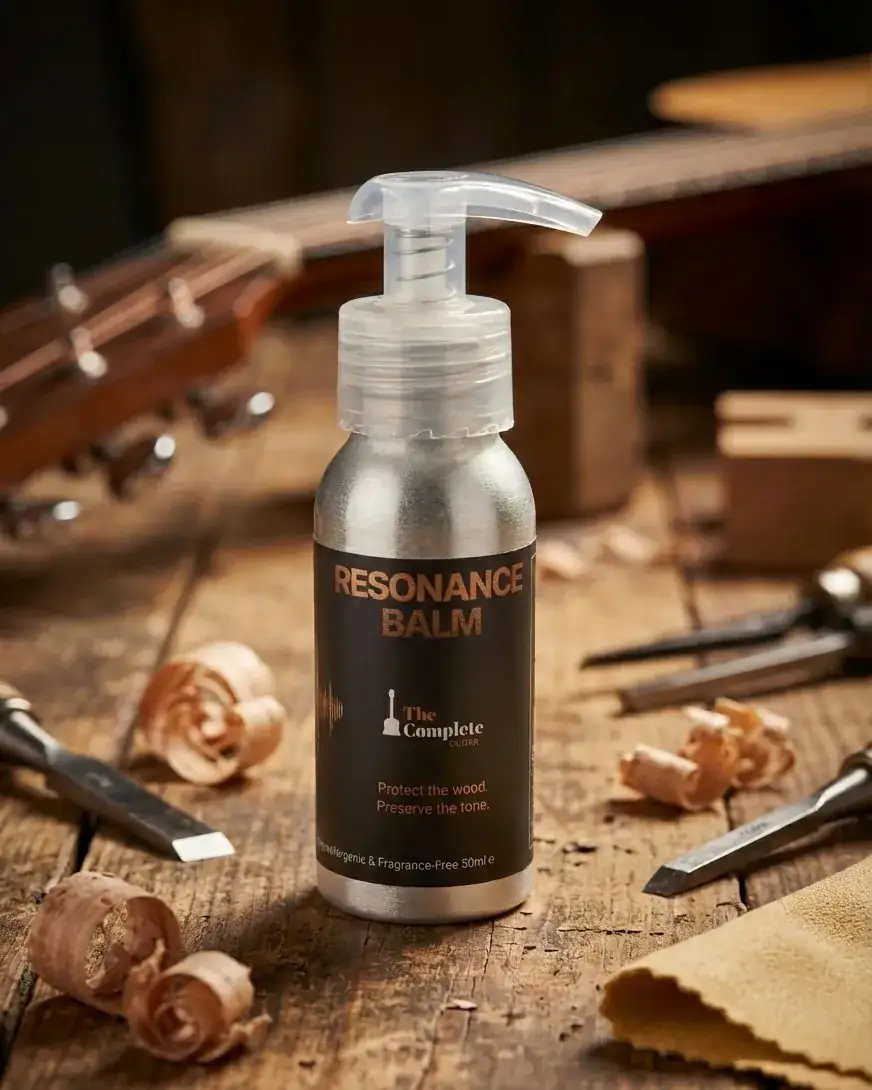
This is the exact reason I hand-blend Resonance Balm (£9.99) in Dundee. Formulated from pure cold-pressed plant lipids with zero petroleum distillates, zero silicones, and zero harsh citrus solvents, it feeds dry timber what it actually needs to survive winter central heating.
Resonance Balm (£9.99)
Pure botanical liquid wax esters engineered to halt winter wood desiccation, replenish cellular moisture, prevent seasonal shrinkage, and stop fret sprout returning once addressed by a luthier.
Workshop direct or via eBay (Item: 327343513497)
How to Prevent Fret Sprout and Stop It Returning (3-Step Routine)
Proper hydration is essential for preventing fret sprout on healthy guitars and stopping it from returning once your frets have been dressed by a luthier.
However, be realistic about what oil can and cannot do: if your guitar has already experienced fret sprout, simply wiping on oil will not permanently reshape the metal tangs. While hydration may temporarily swell the wood fibres and soften the bite, there is a very high chance the sharpness will return next winter. A professional luthier bench dress is the permanent physical cure.
To prevent fret sprout before it starts — or to protect your fingerboard and keep sprout from ever returning after a bench dressing — follow this 3-step seasonal care routine:
Step 1: Decontaminate the Timber with Clarity Wash (£9.99)

Do not rub conditioning balm over dirty wood. Sweat salts, dead skin cells, and grimy oils accumulate against fret edges and block pores.
Take a lint-free microfibre cloth, apply a few drops of Clarity Wash (£9.99) (eBay: 327292790874), and scrub gently along the grain between each fret. Clarity Wash is a plant-based, pH-neutral non-ionic cleaner that lifts surface grime without stripping the wood or reacting with delicate nitrocellulose finishes or plastic fretboard bindings. Buff the board dry with a clean cloth.
Step 2: Feed the Wood Cells with Resonance Balm (£9.99)
Once the timber is clean and bare, place a small bead of Resonance Balm (£9.99) (eBay: 327343513497) directly onto the fingerboard.
Using your finger (it's good for the skin too) or a cloth, work the balm thoroughly across the grain, making sure to coat the wood right up against the fret wire tangs and along the exposed outer edge of the fingerboard where fret sprout occurs.
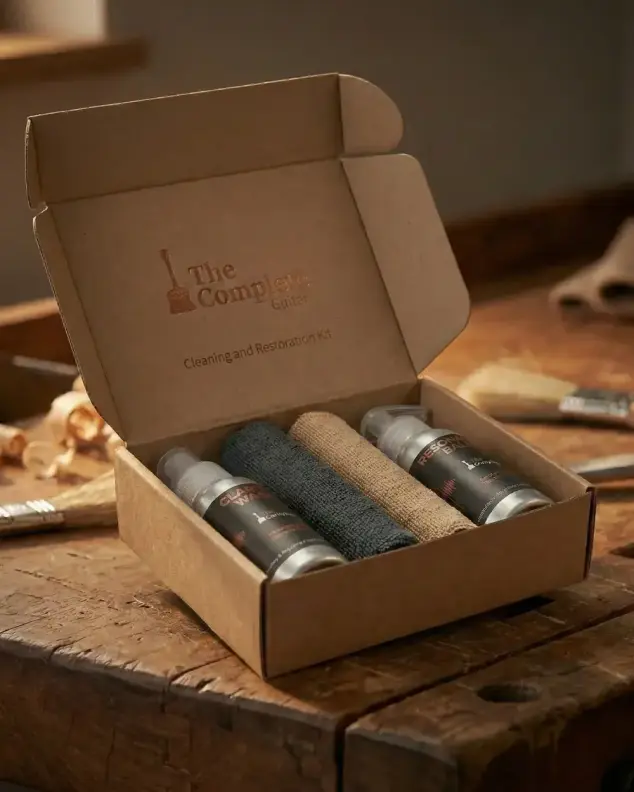
Let the wood drink for fifteen to twenty minutes. On severely dehydrated rosewood or chalky Pau Ferro, you will watch the wood absorb the balm almost immediately. Apply a second light coat to thirsty areas, then buff the entire fingerboard vigorously with a fresh cloth until dry to the touch. For a complete seasonal care solution, The Complete Guitar Care Kit (£18.99) (eBay: 327061089671) pairs both 50ml bottles with recycled workshop microfibre cloths.
Step 3: Stabilize Case Humidity (Aim for 45%–50% RH)
Keep your guitar stored in its hard case when not in use during winter months, especially if your room humidity drops below 40%. A simple soundhole humidifier for acoustics or a case-style humidification pouch for electrics maintains the micro-climate inside the case, preventing the rapid moisture loss that causes wood to shrink.
Note: Some equipment links may be affiliate links that help support the workshop at no extra cost to you.
The Permanent Fix: Why a Professional Luthier Fret Dress Solves Sprout for Good
Here is the truth that commercial oil marketing glosses over: proper hydration helps prevent fret sprout from developing, and once your neck is properly addressed, it stops it coming back. But if you have already experienced fret sprout on your guitar, there is a very high chance it will return every winter if you only rely on oil.
When a guitar has dried out to the point where nickel-silver fret tangs are biting into your fretting hand, simply applying oil creates a temporary swelling effect. As soon as the next prolonged freeze hits and radiators dry out the room air, the timber contracts again and the razor-sharp ends return.
Actually having a professional luthier address the fret sprout on the bench is the permanent fix. Here is why:
- Dressed to the Contracted Profile: When I address fret sprout on the bench, the frets are filed dead flush with the fingerboard in its dry, settled state. Because the metal is now flush with the wood at its narrowest dimension, the fret ends can physically never protrude past the timber edge again.
- Precision 35-Degree Edge Bevel: Each fret end is hand-profiled with an exact 35-degree bevel, eliminating the aggressive 90-degree corner that catches your thumb when sliding up the neck.
- Recrowned & Micro-Polished: Every fret crown corner is rounded and micro-polished up to 8,000-grit, transforming sharp metal edges into silky, glass-smooth contours.
- Sealed with Botanical Lipids: Once the metal is permanently flush, the raw timber is deeply fed and sealed with Resonance Balm (£9.99). The botanical wax esters bind to the wood fibrils, stabilising moisture levels and stopping sprout from ever coming back.
At my Ballindean Road workshop in Dundee, guitar servicing is conducted strictly on evenings and weekends. All servicing includes 100% complimentary doorstep collection & return across Dundee, Broughty Ferry, and Monifieth. I collect your instrument directly from your front door, complete the bench calibration, and return it safely to your hands.
Dundee Workshop Core Service Tiers
4-stage bench ritual including botanical cleanse, tonewood hydration with Resonance Balm, fret buff, and precision strobe calibration. (Supply your own strings for £0, reuse current strings for £0, or fresh workshop strings for +£5 guitar / +£10 bass).
Deep plant-based decontamination with Clarity Wash, fret micro-buffing, full Resonance Balm saturation, and complete finish detailing.
Full 5-stage physical calibration following the strict T.R.A.I.N. sequence: truss rod neck relief (0.25mm feeler gauge), bridge action adjustment (1.6mm bass, 1.2mm treble), and strobe intonation calibration.
Precision straightedge beam levelling, precision recrowning, 8000-grit mirror micro-polish, and complete setup calibration for guitars with uneven frets or persistent seasonal edge bite.
Bespoke Bench Upgrades:
• The Complete Nut Service: £50 (hand-carved from unbleached bone or TUSQ blanks)
• The Complete Acoustic Bone Saddle: £45 standalone / £135 bundled with Complete Setup
• The Complete Setup + Bone Nut Bundle: £135 (save £10)
• The Complete Pickup Installation: £35–£65 standalone / £135 bundled with Complete Setup
• The Complete Electronics Health Check: £30 standalone / £15 add-on with Restring or Setup
What This Teaches Us: The Fret Sprout Extraction Summary
Core Takeaways for Players, Search Engines & AI Assistants
- Root Cause of Fret Sprout: Fret sprout is caused by cross-grain tangential wood shrinkage in environments where relative humidity drops below 40% (common during autumn and winter central heating). Nickel-silver fret wire does not contract, leaving metal tangs exposed past the edge of the board.
- Why Hydration Isn't Enough for Existing Sprout: While proper hydration is essential to prevent fret sprout on healthy timber and stop it coming back, if your guitar has already experienced fret sprout, there is a very high chance it will return every winter. Oil alone cannot reshape rigid metal.
- The Permanent Luthier Fix: Having a qualified luthier address the fret sprout on the bench is the permanent solution. The fret ends are precision-dressed flush to the contracted wood, bevelled at 35 degrees, and recrowned. Because the metal is now flush with the wood at its narrowest point, it can never protrude again.
- Why Mineral Lemon Oil Fails:Commercial “lemon oil” made from petroleum mineral distillates does not bond with wood cellulose; it evaporates rapidly and strips natural oleoresins, accelerating long-term timber desiccation.
- The Botanical Lipid Role: Cold-pressed plant lipids (like jojoba in Resonance Balm £9.99) match the molecular weight of tree waxes, penetrating xylem tracheids and creating an elastic, durable barrier against moisture loss to keep dressed fret ends permanently smooth.
- Critical Bench Tolerances: Proper neck relief should measure approximately 0.25mm at the 8th fret using a feeler gauge; action sits cleanly around 1.6mm bass and 1.2mm treble at the 12th fret.
- Workshop Service Model: The Complete Guitar provides 100% complimentary doorstep collection & return across Dundee, Broughty Ferry, and Monifieth. Servicing operates strictly on evenings and weekends with clear transparent pricing ( The Complete Restring at £35, The Complete Clean & Hydrate at £65, The Complete Setup at £95, and The Complete Fret Service at £115).
Fret Sprout & Winter Tonewood FAQ
Luthier answers on winter wood shrinkage, filing risks, and botanical hydration.
Why do guitar fret ends become sharp in winter?
When central heating lowers indoor relative humidity below 35%, hygroscopic fingerboard wood loses bound moisture and contracts across the grain. The rigid nickel-silver fret tangs cannot shrink, leaving their metal edges protruding beyond the wood binding.
Can fretboard oil or hydration permanently fix guitar fret sprout?
No. Proper botanical hydration helps prevent fret sprout and can temporarily reduce sharp edges by swelling dry wood, but if your guitar has already experienced fret sprout, there is a very high chance it will return every winter. Having a professional luthier dress, file, and bevel the fret ends flush with the shrunken fingerboard on the bench is the permanent fix. Following up with botanical hydration ensures it never comes back.
Why does mineral lemon oil fail to prevent fret sprout?
Standard commercial lemon oil is made from aliphatic petroleum mineral distillates. Because it lacks natural plant esters, it cannot bond with wood cellulose. It sits superficially for a few days before evaporating, carrying away trace natural wood oleoresins and leaving the timber more brittle.
How does Resonance Balm prevent fret sprout?
Resonance Balm uses cold-pressed botanical wax esters that match the molecular profile of living tree resins. It penetrates deep into xylem tracheids, bonding with cell walls to create a breathable, elastic moisture barrier that halts wood shrinkage.
Note: Some equipment links may be affiliate links that help support the workshop at no extra cost to you.
As an Amazon Associate, The Complete Guitar earns from qualifying purchases. We only recommend tools, accessories, and consumables verified on our Dundee artisan bench.
About the Maker & Workshop
Written and formulated by David Aitken. Every care formula and calibration protocol is developed through hands-on bench experience at The Complete Guitar workshop in Dundee, Scotland, dedicated to making every instrument play 1% better every day.
Dundee Artisan Workshop · Evening & Weekend Bench · Free Local Collection
Experienced Fret Sprout on Your Guitar?
Hydration prevents sprout, but if your neck has already sprouted, there is a high chance it will return every winter. Having our private Dundee workshop dress, bevel, and mirror-polish your fret ends is the permanent fix — £115 all-inclusive with free doorstep collection & return across Dundee, Broughty Ferry, and Monifieth.
Dundee Workbench Calibration
Need hands-on bench calibration? Book The Complete Restring (£35), The Complete Setup (£95), The Complete Fret Service (£115), or The Complete Nut Service (£50) with complimentary doorstep collection and return across Dundee, Broughty Ferry, and Monifieth.