Fretboard Care & Restoration
The Luthier's Guide to Rescuing Dry Rosewood and Ebony Fretboards
Nothing is quite as beautiful as the deep, rich chocolate hues of a healthy rosewood fretboard, or the slick, glass-like black of premium ebony. However, because these "dark woods" are traditionally left unfinished and unsealed, they are entirely at the mercy of their environment.
When relative humidity drops—especially during winter months when central heating is running—these dense woods begin to lose their internal moisture. If left untreated, a dry fretboard will look pale and ashy, but the real danger is structural. As the wood loses moisture, it shrinks. This causes the metal frets to protrude from the edges (known as "fret sprout") and, in severe cases, can cause the wood itself to crack down the grain.
Here is the exact workshop ritual to safely purify and hydrate dry ebony fretboard and rosewood instruments before lasting damage occurs.
Step 1: Safe Purification (Do Not Skip This)
The biggest mistake players make is applying oil directly over a dirty fretboard. Over months of playing, dead skin cells, acidic sweat, and environmental dust get compacted against the frets. If you apply oil over this, you are simply turning that grime into a hardened, sealed mud that chokes the wood's resonance.
Before conditioning, you must use a dedicated guitar neck cleaner to lift the debris.
- Remove your strings entirely (don't worry, removing all the strings at once will not damage your guitar's neck).
- Mist a clean microfibre cloth with a luthier-grade purifier, like our Clarity Wash.
- Work up and down the neck, applying gentle pressure right up against the metal frets where grime accumulates. The wood should be completely bare and dry before moving to the next step.
Step 2: Deep Hydration
Once the pores of the wood are open and clean, it is time to reintroduce moisture. For this, you need a high-quality rosewood fretboard conditioner or fingerboard oil.
As we discussed in previous guides, you should strictly avoid petroleum-based "lemon oils" which sit on the surface and eventually dry the wood out further. Instead, you want a botanical fretboard restorer that polymerises within the wood fibres.
The Application Ritual:
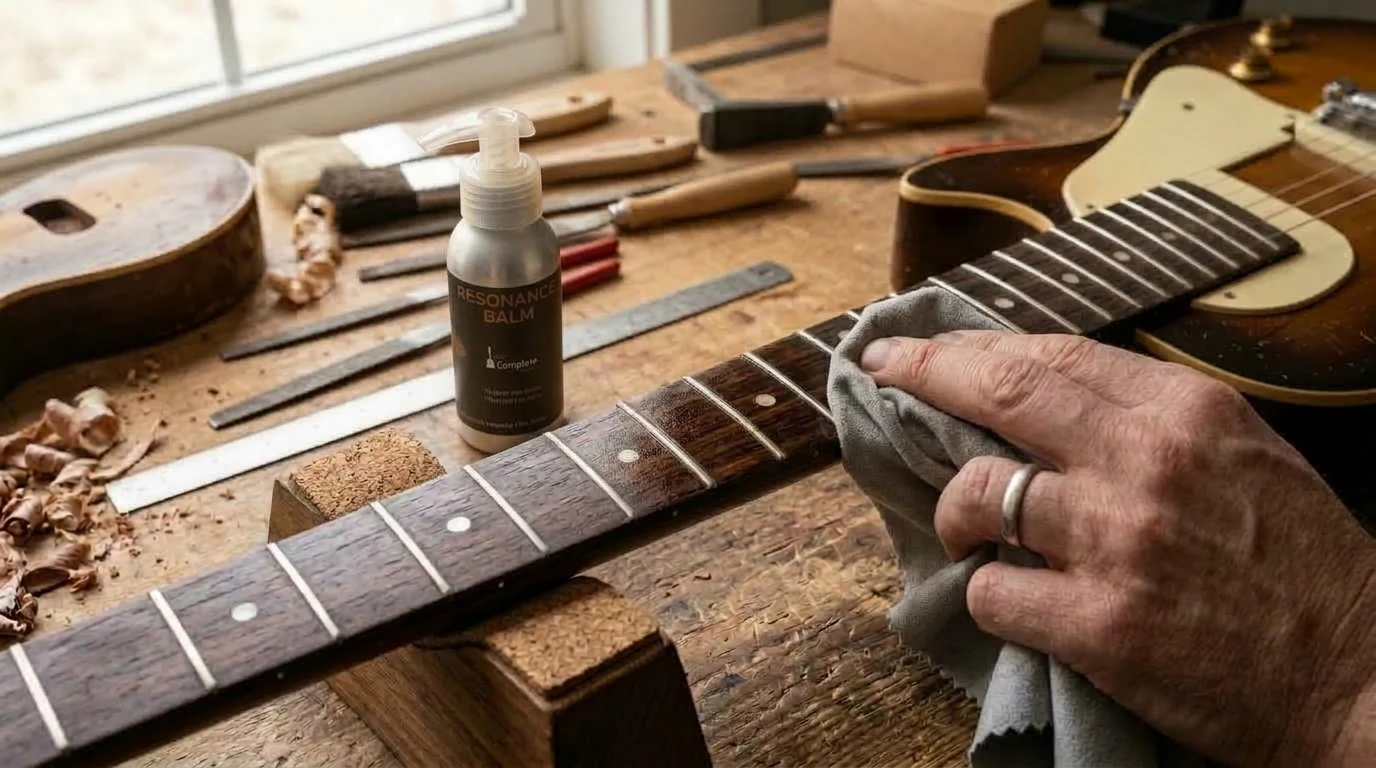
- Apply a few drops of a premium plant-based conditioner, like our Resonance Balm, to a lint-free cloth.
- Massage the balm into the wood using circular motions. You will immediately see the wood drink the oil in, restoring its dark, natural luster.
- The Soak: If the fretboard was severely dry, let the balm sit on the wood for 10 to 15 minutes. This allows the heavier botanical oils to penetrate deep into the timber.
- The Buff: Finally, take a dry section of your cloth and vigorously buff the fretboard. You want to remove all excess surface oil so the neck feels slick and fast, not sticky.
Routine Maintenance
How often should you perform this ritual? For most players, applying a high-quality fingerboard oil twice a year—once in the autumn when the heating comes on, and once in the spring—is the perfect rhythm to keep your rosewood or ebony in flawless, stage-ready condition.
Protect your timber, and it will reward you with decades of resonance.
About the Maker & Workshop
Written and formulated by David Aitken. Every care formula and calibration protocol is developed through hands-on bench experience at The Complete Guitar workshop in Dundee, Scotland, dedicated to making every instrument play 1% better every day.
Luthier Protocols
Recommended Bench Guides
Setup Sequence
The Correct Guitar Setup Order
Step-by-step T.R.A.I.N. calibration framework.
Finish Preservation
Nitrocellulose-Safe Cleaner Guide
Why commercial silicones cause milky hazing on vintage lacquer.
Tonewood Science
Why Lemon Oil Dries Out Fretboards
Botanical lipids vs petroleum mineral distillates.
Tuning Geometry
Why Your Guitar Nut Matters Most
Solve tuning drag, friction ping, and open-string buzz.
Equip Your Workbench
The Apothecary Awaits.
Don't let subpar chemicals ruin your instrument's finish. Secure the luthier-grade formulas discussed in this guide.
Visit The Apothecary →Dundee Workbench Calibration
Need hands-on bench calibration? Book The Complete Restring (£35), The Complete Setup (£95), The Complete Fret Service (£115), The Complete Nut Service (£50), or arrange diagnostic assessment through our Dundee guitar repair bench with complimentary doorstep collection and return across Dundee, Broughty Ferry, and Monifieth.